


By Ed Kaminsky, Kaminsky Real Estate Group · eXp Luxury
I was glad to share my perspective with HomeLight for their new story on how the Nov. 3 election affects California homebuyers, sellers, and renters. Executive Editor Richard Haddad put together a thorough breakdown of the statewide propositions and local measures, and included several of my thoughts from 39 years of helping clients buy and sell in the Los Angeles area.
Read the full HomeLight article here
Below is a quick summary of what passed, plus my take on what it means for you, especially if you own, or hope to own, a home here in the South Bay.
Note: Election results remain unofficial until the state certifies them on Dec. 11, 2026.
Proposition 37: Help with the down payment, not with supply
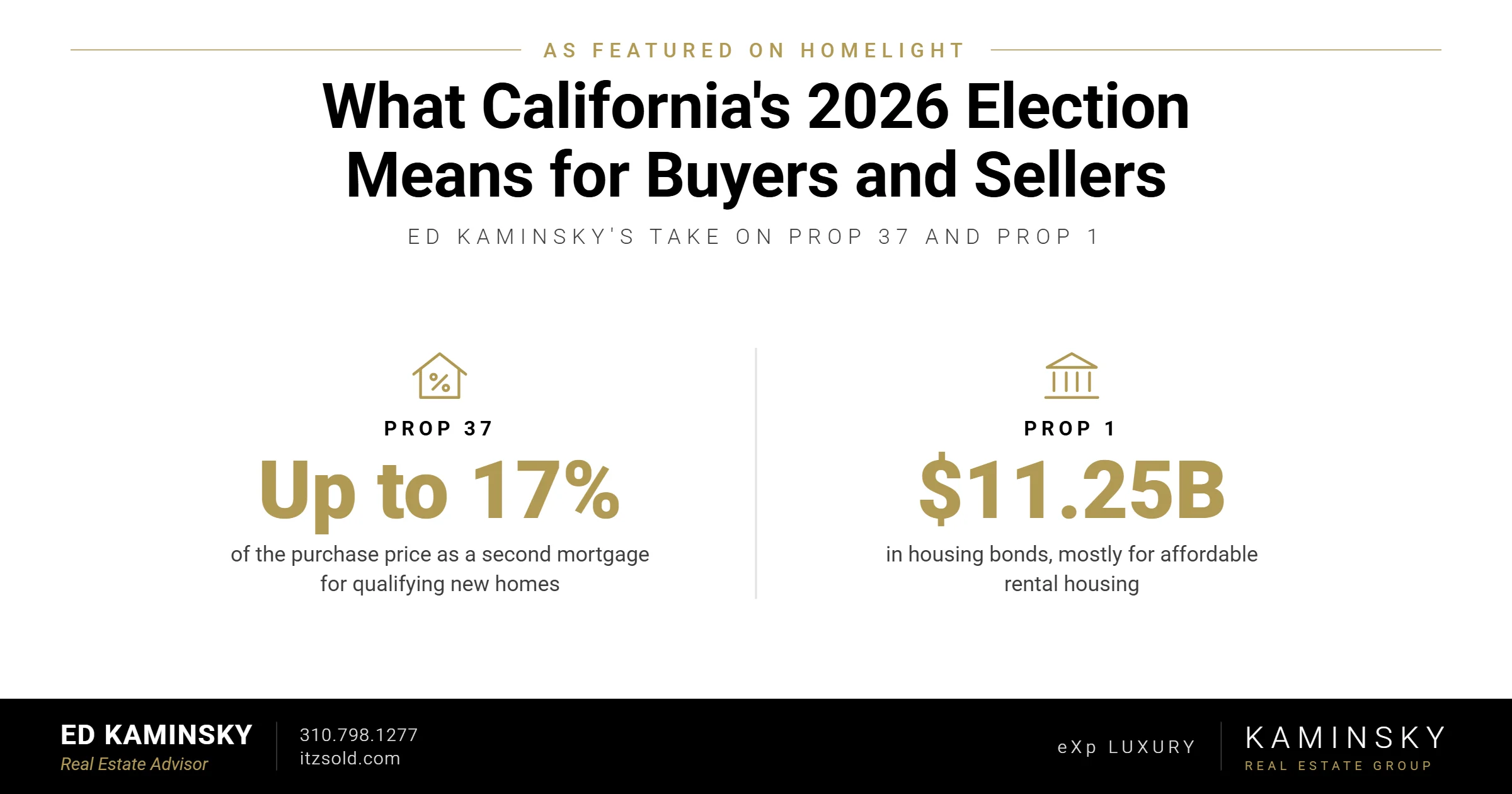
Prop 37 allows the California Housing Finance Agency (CalHFA) to issue up to $25 billion in bonds to fund a new down payment assistance program. Eligible buyers can get a fixed-rate second mortgage covering up to 17% of the purchase price of a qualifying newly built home (or a property converted from nonresidential use).
A few key points:
- It's a loan, not a grant. You still qualify for a primary mortgage and repay both.
- You don't have to be a first-time buyer, but you must be the first owner of the new home and live in it.
- Eligibility basics: at least one year of California residency, household income under twice the area median, at least 3% down from your own funds, and you must work with a licensed California agent.
- Price caps apply, roughly $1 million to $1.5 million depending on the county.
My take: Prop 37 will help most where a household has a strong income but hasn't been able to save a large down payment: young professionals, teachers, nurses, first responders, and growing families who can comfortably handle a monthly payment.
It also gives builders a real advantage in moving inventory. If you're selling a resale home near new construction, expect to compete on price and consider offering your own incentives.
But the biggest barrier hasn't changed. Prop 37 helps with financing; it doesn't add homes, lower land costs, or speed up approvals. As I told HomeLight, "It's a useful tool, but it won't reset the market by itself."
Proposition 1: $11.25 billion, mostly for affordable rentals
Prop 1 authorizes housing bonds aimed primarily at building and preserving affordable rental housing, with smaller amounts for homeownership assistance and veterans' home loans:
- $7.2 billion for affordable rental housing
- $1.1 billion for homeownership programs, including help for eligible first-time buyers
- $1.25 billion for California veterans' home loans
- $1.7 billion for farmworker, student, and tribal housing, infrastructure, and local initiatives
My take: Prop 1 won't lower home prices. The money is spread across the entire state over several years, and it doesn't solve our core problems: not enough supply, high land and construction costs, and slow approvals. For the typical buyer in a coastal market like ours, I don't expect it to move home sales in a meaningful way. It's a positive step for affordable rentals and for veterans, but it isn't a fix for the purchase market.
What this means here in the South Bay
Most of what sells in the South Bay is resale, so the pool of homes that qualify for Prop 37 is thin, and many new coastal homes are priced above the program's caps. Overall, I expect a very small impact on our local market.
In my experience, the market runs on confidence more than policy. People buy when they believe a home will be a good long-term investment and hold back when they fear losing money. That hasn't changed with this election.
Local measures worth watching
Several cities also approved measures affecting transfer taxes, tenant protections, and development. A couple that matter close to home:
- Los Angeles, Measure TE: a one-time exemption from the city's Measure ULA transfer tax for qualifying homes damaged or destroyed in the 2025 Palisades Fire and sold within five years of the fire.
- Santa Monica, Measures RR and VV: expanded eviction protections, including for tenants renting single-family homes and condos.
On transfer taxes generally: in nearby communities that have adopted a "mansion tax," I've met more and more homeowners who decide not to move or sell because of it. In my opinion, that's working against the healthy market these taxes were meant to support.
When will these changes take effect?
Not right away. CalHFA has up to a year after the measure takes effect to launch the Prop 37 program, which puts the deadline around mid-December 2027, and no application date has been announced. Prop 1 funds will also roll out gradually, and local measures each have their own effective dates.
Should you wait to buy?
In 39 years, I've never seen a perfect time to buy. The people who have benefited most from homeownership are the ones who stayed in their homes for the long run, so I don't think short-term changes should derail long-term plans.
My best advice: figure out what you can truly afford and borrow only what you're comfortable with. A lender may approve you for more than you should take on, so set your own budget and shop within it.
Thinking about buying or selling?
If you'd like to talk through how these measures could affect your plans, or what your home could sell for in today's market, I'm always happy to help. Call me at 310.798.1277 or visit itzsold.com.
Ed Kaminsky
Kaminsky Real Estate Group · eXp Luxury
310.798.1277 · itzsold.com
Read the complete story on the HomeLight blog: California 2026 Election: How Buyers, Sellers, and Renters Are Impacted