


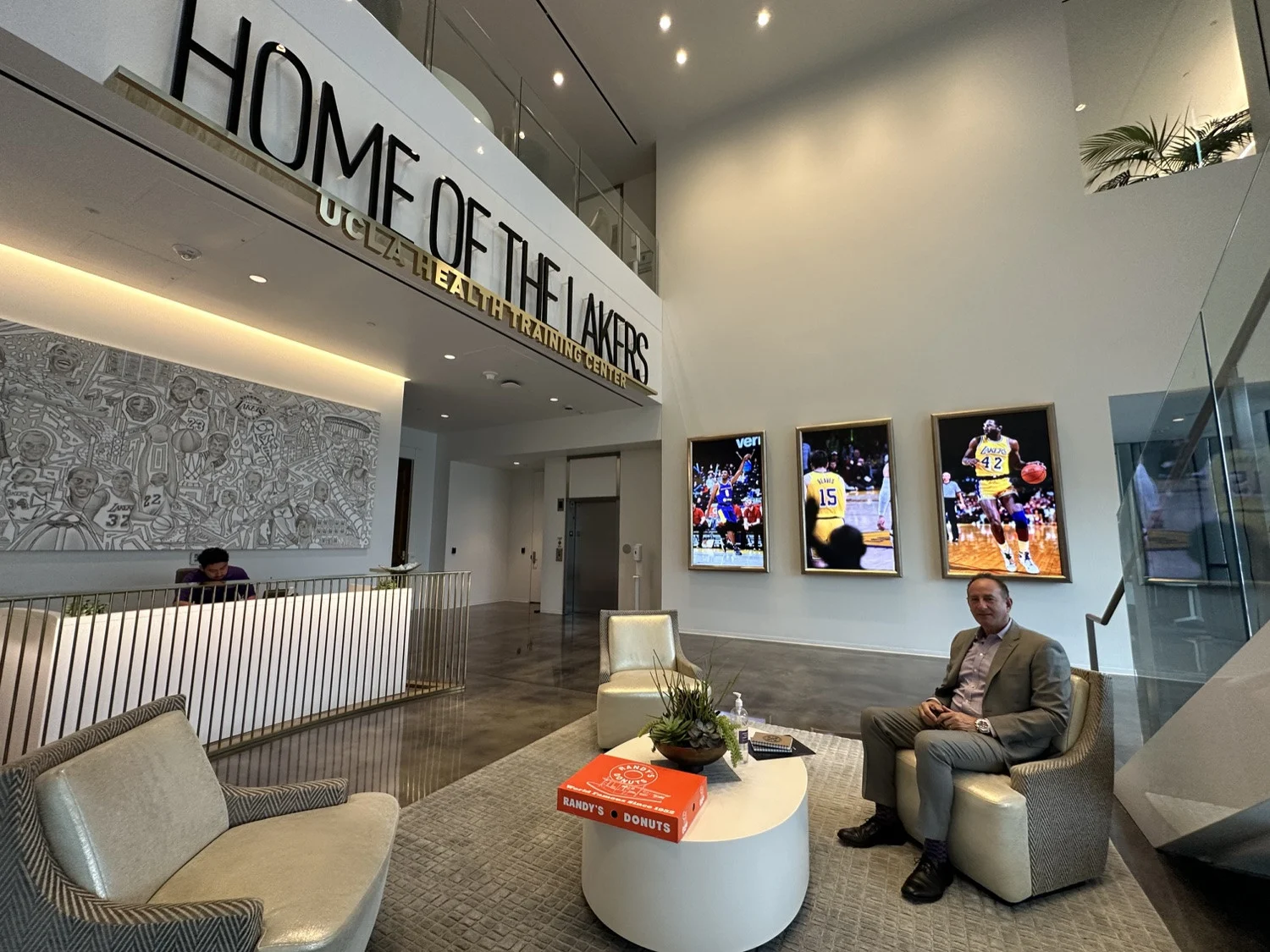
Behind the scenes of professional athlete relocations: privacy, family, multimillion-dollar decisions, and what happens when everything changes overnight
By Ed Kaminsky | Kaminsky Real Estate Group | eXp Luxury | Rocket Bay, Week 12
When people think about professional athletes buying real estate, they imagine enormous contracts, multimillion-dollar homes, and buyers who can afford just about anything they want.
I understand why.
But after decades of working with professional athletes, I've learned that the most important decisions they make about housing often have surprisingly little to do with how much money they're earning.
They're worried about their families. They want privacy. They need homes that work for their lifestyles. Their financial advisors want to protect their wealth.
And unlike most people, they can wake up one morning and discover they're moving across the country.
Those experiences have taught me lessons that apply to virtually everyone purchasing a home in Manhattan Beach, Hermosa Beach, Redondo Beach, Palos Verdes, or anywhere else in Southern California.
Some of my most memorable experiences weren't about finding the most spectacular property or negotiating the lowest price.
They were about understanding what the client actually needed.
Building SportStar Relocation: It's about much more than real estate
More than two decades ago, I founded SportStar Relocation, a national company I continue to own and operate today.

I recognized early that when a professional athlete gets drafted, traded, or signs with a new team, finding a house is only one small part of the challenge.
Think about what happens when an entire family suddenly has to move across the country.
Someone needs to find the right home, coordinate the movers, transport the cars, arrange for personal belongings to arrive, and make sure everything is ready when the family gets there.
Then there are the everyday details most people don't think about until they're living in a new city.
Where will the children go to school? Are private schools an option? Does the family prefer homeschooling? Who can recommend a trusted hairstylist, personal chef, or other service professional?
Every family is different. Every player has different priorities.
That's why I built SportStar Relocation around a full-service concierge approach. Our responsibility goes far beyond finding and negotiating real estate. We coordinate the people, services, and resources a family needs to make the transition as seamlessly as possible.
Sometimes that means helping someone purchase a multimillion-dollar property.
Other times, it means arranging for their cars to arrive, finding the right school, or making sure there's food in the refrigerator when they walk through the door.
The goal is the same: remove as much stress as possible so the athlete can concentrate on their career and their family can settle into a new community.
Expanding that expertise globally through eXp Realty
After joining eXp Realty, I became involved with eXp Sports & Entertainment, the company's global sports and entertainment division.
The division's objective is to bring specialized knowledge, professional standards, and a higher level of service to agents representing athletes, entertainers, and other high-profile clients.
Today, I serve on the eXp Sports & Entertainment council.
It's important to distinguish the two organizations.
SportStar Relocation is the national company I founded and continue to operate.


eXp Sports & Entertainment is a separate global division within eXp Realty, where I contribute my experience in athlete relocation and luxury real estate.
Both reflect a principle I've believed in for decades:
Great representation isn't just about completing a real estate transaction. It's about taking care of the people involved in it.
Lesson 1: The family matters more than the contract
One of the biggest surprises when I first started working with professional athletes was discovering how ordinary their concerns really were.
We tend to think about the glory of professional sports: the multimillion-dollar contract, the excitement of signing with a new team, and the opportunity to live an extraordinary lifestyle.
That excitement is real.
But it disappears quickly when you realize your family has to move across the country, your children may need to change schools, and your spouse or partner has to leave behind an entire community of friends.
Players and their families can become deeply connected to a city.
They establish routines. Their children make friends. Their spouses build relationships. They finally get comfortable.
Then a trade happens.
Everything changes.
Fortunately, Southern California offers an extraordinary lifestyle. For many players, the opportunity to live near the ocean, enjoy our climate, and experience everything Los Angeles offers makes the transition easier.
But that doesn't eliminate the disruption.
One of the first lessons I learned was that keeping the family comfortable and happy often matters far more than the size of the contract.
The Jim Jackson relocation I'll never forget
One of my favorite experiences involved Jim Jackson, who joined the Los Angeles Lakers in 2006.
Jim had played for 12 NBA franchises during his career.
I received a call from his wife, Shawnee. She was exhausted by the constant moving and made it clear that another relocation was not something she was looking forward to.
I made a decision: this was going to be the best moving experience they'd ever had.
The challenge was that they were arriving in less than a week.
I went to work finding them a place to live, but I didn't stop there.
I arranged for the home to be fully furnished. I made sure the beds were ready. I researched their food and beverage preferences and went grocery shopping to stock the refrigerator. I even had the current newspapers waiting for them.
Remember, this was back when people still read newspapers every morning.
When they landed in Los Angeles, they went directly to their new home.
Everything was ready.
They didn't have to find furniture, shop for groceries, or figure out where they were going to sleep that night.
In fact, they hadn't seen the property in person before they arrived.
Shawnee later told me it was her favorite move she'd ever made.
That experience meant a great deal to me personally. It also strengthened my relationship with the Lakers organization, including general manager Mitch Kupchak and his team.

But the biggest lesson had nothing to do with basketball.
Sometimes the most valuable thing you can give a client isn't a better house. It's a better experience.

Ed Kaminsky with Jordan Farmar

Ed Kaminsky with Luke Walton
That applies to every relocation, whether you're a professional athlete arriving on a new contract or a family moving to the South Bay for a new career opportunity.
Lesson 2: Privacy is part of a property's value
Professional athletes value discretion.
Fortunately, the South Bay can be an excellent place for a recognizable athlete to live.
Los Angeles is an enormous and diverse community. There are so many different industries, personalities, and interests that not everybody is focused on professional sports.
Depending on the athlete and the team, a player might be able to walk along the beach, visit a restaurant, or spend time with family without constantly being approached.

That's a tremendous lifestyle benefit.
But privacy still needs to be considered when choosing a home.
A property may be beautiful, expensive, and ideally located, yet lack the separation from the street, screening, or controlled access that a high-profile buyer needs.
And privacy isn't limited to the physical property.
It also involves how carefully the professionals working with the client handle sensitive information.
The Andrew Bynum deal that fell apart—and the one that didn't
I remember representing Andrew Bynum when he was playing for the Los Angeles Lakers.
We spent months searching for the perfect house and eventually found a beautiful brand-new property in Bel Air.
The floor plan was ideal. It accommodated his mother, who would be spending time there, and it had plenty of parking for his substantial collection of cars.
Andrew loved it.
We negotiated the deal, and I thought we were finished.
But Andrew was young, and he had a close personal and business relationship with both his mother and his sports agent. Important decisions were made with all three involved.
At the last minute, his agent raised a concern that changed everything.
He believed Andrew needed much more privacy than the property offered. Specifically, he wanted fencing and gates approximately 8 to 10 feet high surrounding the property.
The fencing wasn't there, and we weren't even certain we could obtain permits to build it.
After months of searching and negotiating, the deal was dead.
But here's the funny part.
There was one thing everybody still agreed on: Andrew needed somewhere to park his cars.
He had about a dozen of them.
So I went looking for something entirely different and found an old automotive repair facility in Hawthorne, relatively close to the Lakers' practice facility, where he could keep his collection.
We didn't end up buying the dream house in Bel Air, but we did find him a property to purchase for his cars. Andrew bought the building.
Not every real estate transaction ends the way you expect.
Sometimes you spend months trying to help somebody buy a magnificent home, only to end up helping them acquire an old car repair shop.
That's the world of professional athlete real estate.
And it's another reminder that understanding what a client really needs can be more valuable than closing the biggest deal on the table.
A photograph worth a thousand blurry words
I have a photograph of Andrew and me from those days.
Unfortunately, it isn't exactly the sharpest photograph ever taken.
But I think that makes it a little more memorable.

What that transaction taught me
The Bynum experience reinforced two important principles.
First, a property can check nearly every box and still fail on one nonnegotiable requirement.
Second, a great real estate advisor needs to be flexible enough to solve problems that may have nothing to do with the original transaction.
Before falling in love with a home, establish the things that truly matter.
Maybe it's privacy. Maybe it's a single-level layout, parking, a usable backyard, or a particular commute.
Whatever those priorities are, identify them early.
A beautiful home that doesn't work for your lifestyle is not the right home. And if a feature is essential, make sure it exists—or can legally and practically be created—before committing to the property.
Lesson 3: The smallest physical details can be the biggest dealbreakers
One thing professional athletes taught me is that physical functionality matters as much as aesthetics.
That's particularly true when working with exceptionally tall clients.
I remember an NFL player who was approximately 6-foot-4 or 6-foot-5.
He rented a home before arriving in Los Angeles.
When he finally walked into the property, he hit his head on the overhead clearance beneath a staircase near the entrance.
Imagine renting a beautiful property and discovering you can't comfortably walk into your own home without ducking.
It was an immediate problem.
Fortunately, the owner was accommodating, and we were able to work out a release from the lease and find a more suitable property.
It sounds like an unusual situation, but it illustrates something important.
When you're working with professional athletes, you need to look beyond the usual checklist of bedrooms, bathrooms, kitchens, and views.
You need to consider ceiling heights, doorway clearances, shower-head placement, and the dimensions of spaces they'll use every day.
A shower head that works perfectly well for an average-height person might be pointed at the stomach of an NBA player.
These aren't necessarily expensive problems, but they can make a home extremely uncomfortable.
Recovery and sleep matter, too
Another important consideration is recovery.
A professional athlete's body is central to their career.
Having convenient access to a sauna, cold plunge, exercise equipment, or other wellness facilities can be very desirable.

Cold plunges at Love.Life Health and Wellness Center

Dumbbells at Love.Life Health and Wellness Center
They may already have these features available through their team's facilities, but having them at home creates convenience and flexibility.
Sleep is another consideration that most buyers underestimate.
In hockey, for example, many players have a game-day routine that includes an afternoon nap.
A quiet bedroom that can be completely darkened becomes an important feature.
A spectacular house with enormous windows and beautiful natural light might actually require significant modifications to accommodate that routine.
The takeaway for everyone is simple:
Don't evaluate a house only by how it looks during a showing. Think about how you'll actually live in it.
Walk through your ordinary day in your mind.
Think about the things you use, the spaces you need, and the inconveniences that might frustrate you after moving in.
Those details can make the difference between a house you admire and a home you truly enjoy.
Lesson 4: The most important person in the transaction might not be the buyer
People sometimes assume that when you're representing a professional athlete, your primary relationship is with the player.
That's not always the case.
Many athletes have sophisticated advisory teams that include a sports agent, financial advisor, CPA, and attorney.
Sometimes you spend only five minutes interacting with the athlete during a showing, while nearly all the important financial and contractual discussions take place with their advisors.
In other situations, the financial team handles most of the property search and transaction coordination, consulting directly with the player.
That means you need to establish credibility and trust with the entire advisory team.

They aren't simply asking whether the property is beautiful.
They want to know whether the price is justified.
They want to understand the local market.
They want to know how much financial exposure exists if the player is traded a year or two later.
And they want confidence that the real estate professional understands the difference between what a player can afford and what makes financial sense.
If a player is considering a $10 million, $15 million, or $20 million property, the financial team may ask difficult questions about resale value, liquidity, transaction costs, and how easily the home could be sold.
Those are reasonable questions.
Sometimes a financial loss is an acceptable decision
Not every real estate purchase needs to be justified as the highest-return investment.
Imagine an athlete with a substantial contract who wants to buy a home rather than rent.
Suppose there's a possibility that buying and reselling after two years could result in a $500,000 loss after the relevant transaction costs and market changes.
That sounds like a large amount of money, and it is.
But what if renting a comparable home for those two years would also cost approximately $500,000?
The purchase may still be worth considering, depending on financing costs, taxes, carrying costs, expected resale value, and how much the player values the home.
That doesn't make buying automatically better than renting. It means the decision deserves a complete financial comparison.
For some clients, the opportunity to live in exactly the property they want, with the privacy and amenities they need, justifies a financial cost.
For others, the same decision would be irresponsible.
My role is to make sure the client and the advisory team understand the choices.
The right decision isn't always the one with the lowest price. It's the one that makes the most sense for the client's circumstances.
Lesson 5: Always ask what happens if the client has to move
This may be the most important question I ask professional athletes.
Before recommending that they purchase a home, I want to know:
If you were traded tomorrow, what would you do with the property?
Would you keep it as a vacation home?
Would you want to return to the area in the future?
Could it become an investment property?
Or would you need to sell it immediately?
Those are completely different situations.
If the player intends to retain the property as a second residence or long-term investment, a short period of playing time in Los Angeles may not be particularly concerning.
But if the player knows they would need to sell as soon as they're traded, we need to examine the financial risks much more carefully.
A beautiful home in Manhattan Beach might be a wonderful long-term investment but a poor short-term purchase.
Real estate has transaction costs. The market can change. Selling quickly can be expensive.
I remember a professional athlete who bought a beautiful home in the Hill Section of Manhattan Beach and was traded approximately 24 hours after escrow closed.
That is an extraordinarily difficult situation.
The property hadn't suddenly become undesirable. But the buyer's circumstances had changed almost overnight.
That kind of experience is why I sometimes spend time convincing an athlete not to buy.
There's nothing wrong with renting when the player's future in a city is uncertain.
In other cases, buying makes complete sense, particularly when the property could serve a valuable purpose even after the player's career takes them somewhere else.
The key is discussing those possibilities before the purchase, not after the trade.
Why a trade clause can be essential
Even renting can create unexpected financial problems.
A player may arrive in Los Angeles and find that the properties they want are available only with a one-year lease.
But that player might be on the bubble.
They could be traded three or four months into the season.
Without appropriate lease provisions, the player could remain obligated to pay rent after leaving town.
Through SportStar Relocation, we're very strategic about these situations.
We often try to negotiate what we call a trade clause.
The clause is designed to address what happens if a player is transferred before the lease expires, providing a negotiated way to resolve the remaining commitment.
The exact terms depend on the agreement and must work for both the tenant and the property owner.
It isn't an automatic right, and the provisions need to be carefully documented.
But the principle is important.
Negotiate for the unexpected before it happens.
That lesson applies just as much to someone relocating for a corporate position, accepting a temporary assignment, or uncertain whether they'll remain in Southern California.
Lesson 6: A good advisor protects you from the problems you don't know exist
Some of the most difficult situations I've seen happened outside Southern California, where professional athletes moved into unfamiliar markets without adequate local guidance.
I remember a situation involving an athlete who purchased a home in New Jersey.
The player soon discovered that the neighborhood didn't provide the privacy or lifestyle the family expected.
They were frequently recognized and approached by people in the area, making everyday life uncomfortable.
The athlete had worked with an agent outside our SportStar Relocation network.
From what I learned about the situation, the original consultation hadn't adequately addressed the family's needs or the property's long-term financial suitability.
Through our network, I arranged for someone to step in and help the client work through the problem, including finding a more appropriate housing situation.
But the real issue wasn't simply finding another house.
It was having the conversation that should have occurred at the beginning.
What matters most to the family?
How much privacy do they require?
What does the neighborhood offer?
What are the risks if they need to relocate?
Is the property financially appropriate for their circumstances?
Those are questions a knowledgeable real estate advisor should help answer before the client commits.
And they don't apply only to athletes.
Every buyer can benefit from a professional who is willing to challenge assumptions, point out hidden problems, and occasionally recommend walking away.
What every South Bay buyer can learn from professional athletes
After all these experiences, I've come to believe that professional athletes often encounter a more extreme version of the same real estate decisions everyone else faces.
Their timelines may be shorter.
Their privacy needs may be greater.
Their advisory teams may be more extensive.
Their income may arrive in unusually large amounts.
But the underlying questions are remarkably familiar.
Will my family be happy here?
Does the property actually fit how we live?
Am I buying at a sensible value?
What happens if my circumstances change?
Have I surrounded myself with people who are helping me make a good decision?
The same questions matter whether you're buying a $2 million home in Redondo Beach, a $5 million home in Manhattan Beach, or a $20 million estate elsewhere in Los Angeles.
Five questions I'd ask before purchasing
1. If my life changed tomorrow, what would I do with this home?
Consider relocation, career changes, family needs, and the possibility of selling sooner than expected.
2. Am I choosing the house based on how it looks or how it functions?
Evaluate privacy, layout, access, parking, maintenance, and the details of everyday living.
3. Who else needs to be involved in this decision?
Include the spouse, partner, family members, financial advisors, or other professionals whose guidance will matter.
4. Have I compared the financial consequences of buying and renting?
Evaluate the likely holding period, housing costs, transaction expenses, and potential resale outcomes. Don't assume that buying is always the financially superior choice.
5. Are the transaction terms protecting my interests?
The closing schedule, contingencies, lease provisions, possession arrangements, and other contractual terms can matter as much as the headline price.
The biggest lesson of all
I've been selling South Bay real estate since 1987 and have closed more than $4 billion in transactions.
Over the years, I've worked with people buying their first homes, sophisticated investors, luxury buyers, and professional athletes whose careers and financial circumstances are very different from most people's.
But the lesson that has stayed with me is surprisingly simple.
A successful real estate transaction isn't necessarily the most expensive home, the lowest negotiated price, or the fastest closing.
It's a decision that makes sense for the client's life.
Sometimes that means finding the perfect house.
Sometimes it means negotiating protections that most buyers would never think to request.
And sometimes it means advising a client not to buy anything at all.
One of the things professional athletes taught me is that circumstances can change in an instant.
The right home, the right advisors, and the right strategy should account for that possibility before the contract is signed.
That's a lesson every South Bay buyer can use.
One of my greatest sports memories
One of my greatest sports memories, by far, came the day the Los Angeles Kings won their first Stanley Cup in 2012. I was excited and proud to be sitting on the glass when LA got its first Stanley Cup, and the players came over to us to high-five. These photos are from that day, and that was my crew. And yes, Cindy and I got our moment with the Cup.

Ed Kaminsky at Staples Center the day the LA Kings won their first Stanley Cup

Ed Kaminsky with his daughter Tina and friends at the 2012 Stanley Cup Final

Ed and Cindy Kaminsky with the 2012 Stanley Cup
“I'm not selling my house. ...Unless someone meets my buy-it-now price.”
Name your number. What's yours? Tell Ed privately.
Not every home draws a premium, and some sellers ask far more than any buyer will pay.
About Ed Kaminsky
Ed Kaminsky is the founder and CEO of Kaminsky Real Estate Group at eXp Luxury and the founder of SportStar Relocation, a national athlete relocation and concierge services company.
He also serves on the eXp Sports & Entertainment council. eXp Sports & Entertainment is eXp Realty's global sports and entertainment division.
Licensed since 1987, Ed has closed over $4 billion in real estate transactions and specializes in luxury residential real estate throughout Manhattan Beach, Hermosa Beach, Redondo Beach, and the Palos Verdes Peninsula.
Kaminsky Real Estate Group | eXp Luxury
Sources and notes: The stories in this article are from Ed Kaminsky's professional experience and recollection. Jim Jackson's signing with the Lakers is from the team's March 6, 2006 announcement. The $500,000 rent-versus-buy figures are a hypothetical illustration, not a specific transaction. Opinions are Ed Kaminsky's.
Photo credits: All photos supplied by Ed Kaminsky.
Navigating a liquidity event?
If SpaceX stock, a company sale or another windfall has changed what is possible for you, the next few decisions matter more than the purchase price. Kaminsky Real Estate Group works with South Bay buyers navigating equity, taxes, timing and off-market opportunities every day.
Schedule a private strategy session →

Ed Kaminsky Kaminsky Real Estate Group · eXp Luxury
#1 Real Estate Agent in the South Bay · Top 15 in the Nation (RealTrends) · Over $4 Billion Sold