

I’ve watched the South Bay change for more than 40 years. I think another change is beginning.
When I came to the South Bay from Cleveland in 1983, it was a completely different place.
Manhattan Beach, Hermosa and Redondo felt like true beach towns. You came down here and became part of the fabric of a casual beach community.
Downtown Manhattan Beach had T-shirt shops, sandwich places, pizza joints, little restaurants and small local businesses. Aerospace was a huge part of the South Bay economy. My recollection is that a lot of the people you met worked somewhere in aerospace, while many of the more affluent residents were doctors, lawyers or successful business owners.
I started selling real estate here in 1987, so I’ve had a front-row seat to almost 40 years of what happened next.
And what happened is pretty remarkable.
Manhattan Beach didn’t get much bigger
Here is one statistic that may tell the story better than anything else.
Manhattan Beach had 31,542 residents in 1980. By 1990, it had 32,063. The latest Census estimate puts the 2025 population at about 33,122. In other words, over more than four decades, the population barely moved compared with the enormous change in the value of the real estate.
Now look at housing.
An Associated Press report published in 1983 said the median Manhattan Beach home price had risen from $31,100 in 1970 to about $159,700 in 1980. By July 2000, the median sale price was about $722,500. Zillow reported a Manhattan Beach median sale price of approximately $3.49 million in June 2026.
Those aren't perfectly identical datasets, and the older numbers are obviously nominal dollars, not inflation-adjusted. But the basic story is impossible to miss:
Manhattan Beach didn't become four or five times larger. It became dramatically more valuable.
Then & now
1980s
Today
Manhattan Beach population
31,542 (1980)
~33,122 (2025 est.)
Manhattan Beach median home price
~$159,700 (1980)
~$3.49 million (June 2026)
30-year mortgage rate
13%+ (early 1983)
6.76% (Sept. 10, 2026)
Sources: U.S. Census Bureau, Associated Press (1983), Zillow, Freddie Mac. Older figures are nominal dollars, not inflation-adjusted.
The question is why.
The first South Bay I knew was heavily aerospace
When I arrived, aerospace was part of the identity of this area.
Then the late 1980s and early 1990s hit.
The Cold War ended. Defense spending was cut. Aerospace employment dropped sharply, and Southern California took a disproportionate share of the damage.
This isn't just my memory.
California aerospace employment fell from roughly 370,000 jobs in 1988 to just over 160,000 in 1996, according to a California Legislative Analyst's Office review. About four-fifths of the job losses occurred in Southern California, and nearly two-thirds were in Los Angeles County.
You could feel it locally.
A 1991 Los Angeles Times report described sizable employment cuts at McDonnell Douglas in Torrance, Rockwell in El Segundo, TRW and Northrop, and talked about the economic ripple moving through South Bay businesses and housing.
The real estate market struggled.
I remember the downturn lasting into the middle of the 1990s. Around 1995 and 1996, things started to feel different again.
And then the South Bay began another transformation.
The homes themselves started changing
This is one of the changes I think gets overlooked.
For years, a large percentage of the new homes in Manhattan Beach were built by spec builders.
A good spec builder has to be disciplined.
They are trying to build a beautiful home that a buyer wants, but they also have a budget. They have carrying costs. They have risk. And at the end of the project, they have to make a profit.
Then something changed after the financial crisis.
Many builders had been badly hurt during 2008 through 2010. When the market began recovering around 2011 and 2012, demand for new homes came back, but there weren't necessarily enough spec homes to satisfy it.
More homeowners started buying older properties themselves and building their own homes.
And homeowners make decisions differently from developers.
I'll use windows because it is an easy example.
A builder may have a window package that works perfectly well within the budget.
The homeowner goes into the showroom.
They see the window the builder selected.
Then they see another one.
“What's the difference between this one and that one?”
Maybe one window is a few hundred dollars more.
That doesn't sound too bad.
Until you need dozens and dozens of windows.
Now repeat that decision with flooring.
Tile.
Lighting.
Appliances.
Doors.
Plumbing fixtures.
Audio and video.
Home automation.
Landscaping.
You can take a home that could have been built for one number and spend hundreds of thousands of dollars more — sometimes considerably more — because every decision is based on, “Which one do I like better?”
And here is where it gets interesting.
The next person walks into that house and says:
“Wow. I want that.”
What used to be an upgrade starts becoming the expectation.
The quality of the market gets pushed higher.
Premium architects and builders come in. Better materials become common. Some spec builders see where the market is headed and start building at a higher level themselves.
The whole housing stock moves up.
I can't give you a government statistic that tells you exactly what percentage of Manhattan Beach construction shifted from spec-built to owner-built custom homes. That's my observation from doing this business every day.
But I have watched the result.
The homes became better.
Then the town followed the homes
As the financial strength of the residents changed, so did the community around them.
Restaurants improved.
Retail changed.
Services changed.
The customer base became more affluent, and businesses responded to the customer.
A Los Angeles Times story from 1992 was already documenting this change. It noted that Manhattan Beach's traditional aerospace-oriented resident base was giving way to increasingly affluent professional households.
So this didn't happen overnight.
It happened in waves.
And I understand why not everybody loves every part of it.
Some longtime residents miss the old beach town.
I understand that.
There was something great about a Manhattan Beach where a teacher, an aerospace employee or a regular working family had a realistic shot at buying close to the beach.
A 1999 Los Angeles Times story actually described that older Manhattan Beach as a place where a teacher's or aerospace worker's income once could support a modest home near the ocean.
One of the hard parts about what Manhattan Beach has become is that children can grow up here and later discover they can't afford to move back into the community where they were raised.
That is not something I dismiss.
But it is difficult to stop change.
What hasn't changed
For all the transformation, the fundamental attraction of the South Bay is remarkably consistent.
The ocean.
The climate.
The schools.
The lifestyle.
LAX nearby.
Access to Los Angeles.
And something I think gets underestimated: community.
One of my favorite things about Manhattan Beach is that it can still feel like a small town.
You see it at the Hometown Fair.
You see it at the pier lighting and the fireworks.
You see it at the Friendship Foundation's walk with Skechers.
You see it at the wine auction.
People come together in a way that sometimes reminds me of growing up around Cleveland, where everybody seemed to show up for the Fourth of July.
Except this little community is sitting next to one of the largest cities in America.
That combination is hard to duplicate.
A little perspective on mortgage rates
Now let's talk about something everybody complains about today: interest rates.
If you bought or refinanced when mortgage rates were in the 2% range, today's rates feel terrible.
I understand.
But they aren't historically unusual.
Freddie Mac's historical data show 30-year mortgage rates were above 13% when I arrived in early 1983, dipped into the mid-12s that spring and were back around 14% by August. As of September 10, 2026, Freddie Mac's national 30-year fixed average was 6.76%.
So when somebody tells me 6% or 7% is impossible, I have a little different perspective.
I'm not saying today's rates don't hurt affordability.
They do.
I'm saying the 2½% world was the unusual part.
If you're waiting for that to become normal again, you might want to get serious about longevity.
Then something nobody predicted happened
The Palisades fire introduced an entirely new source of South Bay demand.
Families were suddenly displaced.
They needed somewhere to live.
Some came south.
Some rented.
Some bought.
Some enrolled children in Manhattan Beach schools.
Manhattan Beach Unified's emergency enrollment from displaced communities peaked at 231 students. Of those, 159 finished the 2024–25 school year in MBUSD, and 76 from the original group were still enrolled during the following school year. Importantly, emergency enrollment did not require permanent Manhattan Beach residency, so those numbers should not be treated as 231 families permanently moving here.
But it shows how quickly outside events can create demand in a small market.
And some families who came here temporarily discovered something.
They liked it.
They experienced the schools.
They experienced the beach.
They experienced the community.
Some will eventually go back.
Some probably won't.
Athletes are another part of the story
I've worked with professional athletes for more than 30 years through SportStar Relocation.
They have their own real estate priorities.
Privacy.
Security.
Speed.
Convenience.
Quality.
Resale.
And we've continued to see high-level athletes choose this area.
One very visible example was Luka Dončić's $25 million off-market purchase of Maria Sharapova's Manhattan Beach home in 2025. Public reporting later described it as the city's highest-priced home sale at the time, second only to the highest sale to date, which I had on The Strand at $25.5 million.
Dončić's sale was also off market.
That matters to another part of this story that I'll come back to.
And now we have SpaceX
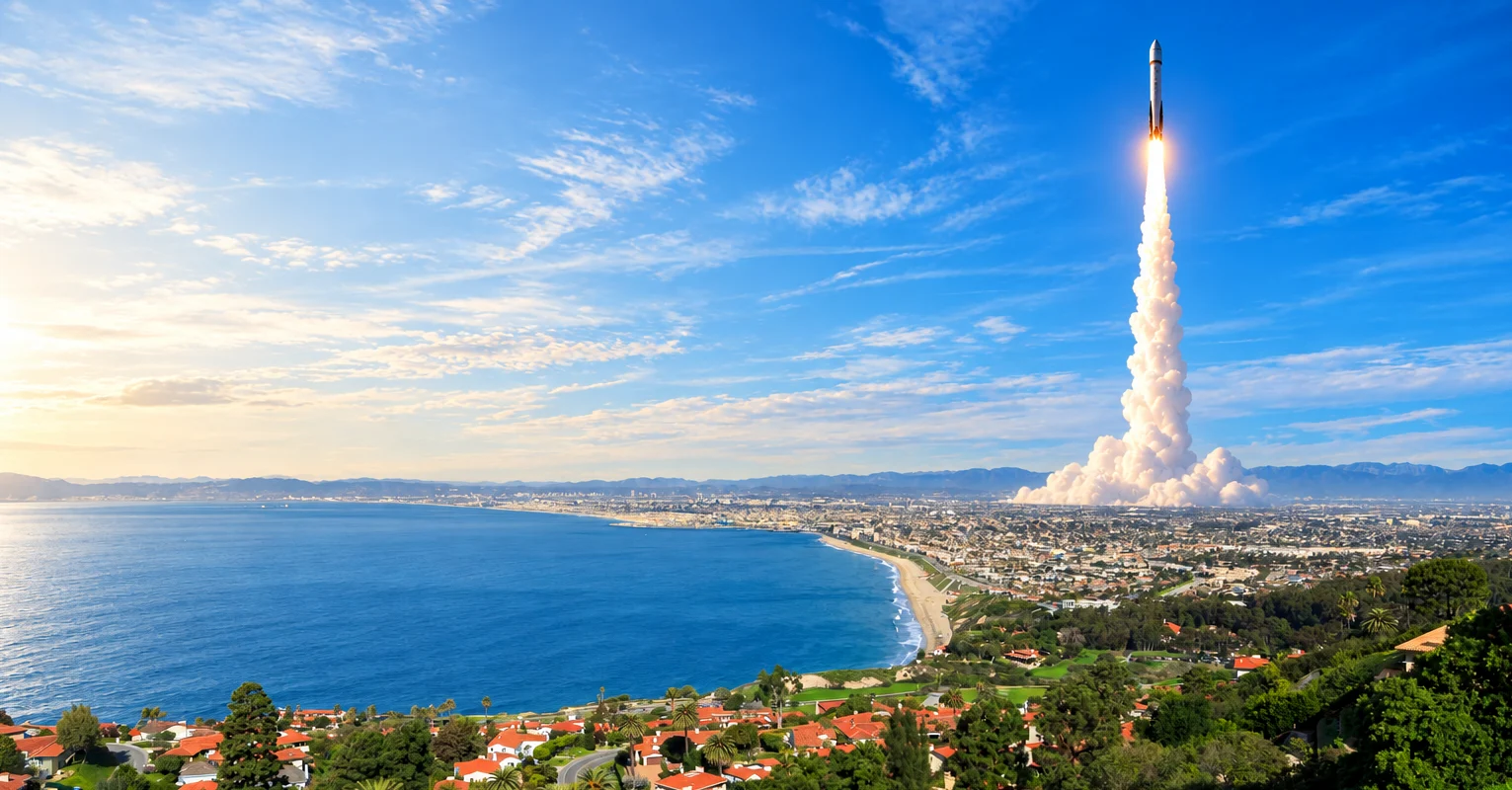
This is where Rocket Bay really begins.
On June 12, 2026, SpaceX went public in what was reported as the largest IPO in U.S. history.
Estimates around the offering suggested approximately 4,400 current and former SpaceX employees would hold stakes worth at least $1 million, with roughly 400 holding more than $100 million in stock.
Those are extraordinary numbers.
But here's where I want to be careful.
That does not mean 4,400 people suddenly received a pile of cash and started shopping for houses.
Stock value and liquidity are different things.
Taxes matter.
Personal decisions matter.
Restrictions on selling matter.
SpaceX also used an unusual staged lockup structure. Some restricted shares became eligible to trade earlier than the standard six-month period, while other blocks remained restricted and were scheduled to unlock over time.
So I wouldn't look at those 4,400 people and say, “Here come 4,400 South Bay buyers.”
That's silly.
But they don't all have to buy here.
Twenty buyers can matter
This is the part I think people underestimate about luxury real estate.
Imagine 20 additional highly qualified buyers.
Or 50.
Or 100.
In a giant metropolitan housing market, that number might disappear.
But Manhattan Beach is tiny.
As one snapshot, the MLS shows only 69 homes for sale citywide as of Sept 2026, across the entire market and all price points.
Now narrow that number down.
How many are new construction?
How many have ocean views?
How many have a pool?
How many are on a larger lot?
How many are on the street you want?
How many have privacy?
How many are actually the quality a buyer with $10 million or $20 million wants?
Suddenly 69 isn't 69 anymore.
It may be five.
It may be two.
Sometimes it is one.
Sometimes it is zero.
Wealth changes the limitation
Most people grow up with some picture in their head of what their dream home looks like.
The pool.
The view.
The size.
The kitchen.
The yard.
Whatever it is.
Then they grow up, start earning money and discover there is a financial wall around that dream.
You come to Manhattan Beach and say:
“I have $3 million. I want a beautiful large house with a pool and an ocean view.”
Then you start looking.
And you say:
“Wait. Is this all I get?”
But if $3 million is your limit, that is the market you have to work within.
Now imagine the financial wall moves.
Maybe dramatically.
That's what happens in a large wealth-creation event.
For some buyers the question changes from:
“What can I afford?”
to:
“Where is it?”
That is completely different.
Because now money isn't necessarily the constraint.
Availability is.
And the best house may not be for sale
This is another thing people from outside the South Bay don't always appreciate.
Not every property becomes a normal public listing.
Some sales happen privately.
Some begin through relationships long before anybody sees the property online.
Sometimes an owner isn't actively selling but might sell if the right buyer appears.
That is why knowing the market means more than knowing how to search the MLS.
And even when the right home comes to market, there is a second challenge.
Can you get it?
If there are multiple offers, it isn't always simply a matter of writing the highest number.
Terms matter.
Certainty matters.
Timing matters.
The seller's next move matters.
How the offer is presented matters.
There are skills that agents develop after doing this for decades.
That's probably an entire article by itself.
None of this means real estate can't go down
I want to make this point because I don't believe in telling people real estate is automatically a great investment at any price.
It isn't.
I've lived through the early 1990s.
I've lived through 2008.
I've watched values decline.
If you buy an expensive property and need to sell a year or two later, there is absolutely a chance you could lose money.
There is no guarantee.
High-end real estate is particularly dangerous when somebody treats a long-term asset like a short-term trade.
But over longer periods, I believe the fundamentals become much more important.
And the South Bay has some pretty powerful fundamentals.
Limited land.
A coastal location.
A desirable climate.
Strong demand for the schools and lifestyle.
Proximity to LAX.
Access to one of the world's major business centers.
A growing pool of financially strong residents.
And now another major wealth-creation event happening practically next door.
So what happens next?
I don't know exactly.
And I'm not going to manufacture a prediction just because a big number makes a good headline.
I'm not telling you SpaceX will make Manhattan Beach prices go up 10%, 20% or any other specific amount.
Nobody knows.
What I do believe is that additional financially capable buyers entering a highly supply-constrained market put pressure on the best properties.
The Palisades families can have an impact.
Professional athletes can have an impact.
Entrepreneurs and executives can have an impact.
SpaceX employees can have an impact.
Business owners who sell companies for $50 million or $500 million can have an impact.
They don't all have to come.
A relatively small number can matter.
I've watched the South Bay reinvent itself several times since I arrived in 1983.
Aerospace helped define the South Bay I first knew.
The aerospace contraction helped end one chapter.
The rebound brought another construction boom.
The financial crisis changed the builders.
Homeowners raised the standard of new construction.
The changing residents helped reshape restaurants and retail.
Finance, technology, entrepreneurship and professional sports brought new kinds of wealth.
Then Palisades families unexpectedly discovered the area.
And now aerospace-created wealth is back in the story again — this time through SpaceX.
The cast changes.
The source of the money changes.
But one thing hasn't.
People still want to live here.
And there still isn't any more land.
That's why I think we're watching the beginning of another chapter.
Welcome to Rocket Bay.
Navigating a liquidity event?
If SpaceX stock, a company sale or another windfall has changed what is possible for you, the next few decisions matter more than the purchase price. Kaminsky Real Estate Group works with South Bay buyers navigating equity, taxes, timing and off-market opportunities every day.
Schedule a private strategy session →
Ed Kaminsky Kaminsky Real Estate Group · eXp Luxury
#1 Real Estate Agent in the South Bay · Top 15 in the Nation (RealTrends) · Over $4 Billion Sold